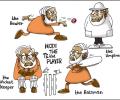
'Eventually the law of averages has to play catch up with Modi and the BJP, sooner or later,' says Rajeev Sharma.
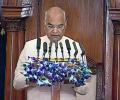
The president also pitched for simultaneous elections to Parliament and state assemblies, saying there was a need to discuss and build a consensus among all parties on the possibility of holding simultaneous polls.

'If we keep losing such institutions, we will soon become a city and culture of short-term memory.' 'Nothing to remind us of the years gone by and eventually with nothing to remember.'

The return of a BJP-Sena regime after a love-hate war and gap of 15 years, demise of senior Bharatiya Janata Party leader Gopinath Munde, collapse of Congress-Nationalisy Congress Party alliance and rising cases of farmers' suicides dominated Maharashtra's political landscape in 2014.

Real and digital world will converge to sell products and services.

'The human tragedy in Gorakhpur has left me jolted,' he said.


"GST should not become a 'grossly scary tax'. It should be a 'good and simple tax'," Surjewala said.
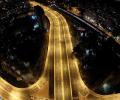
Be it roads, railways, ports, civil aviation, energy or electricity, the Narendra Modi govt has invigorated all these sectors since it took over, says Arvind Panagariya.

The Supreme Court ordered state-run power producer NTPC on Friday not to disconnect power supplies to distribution companies in the capital New Delhi until March 26, averting a potential blackout next week.

The AAP leader resurrected his political fortunes by making changes to his approach
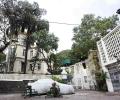
Every blade of grass and grain of sand in Mehrangir has a story to tell: The story of how one of the greatest sons of India lived here, planned and executed from here a technological and scientific enterprise which became the envy of the world. The government must save Mehrangir for future generations, says Dr K S Parthasarathy.

The Finance Commission has substantially increased the allocation of funds to panchayats, but a large part of it is apportioned by state governments.

Uttar Pradesh Chief Minister Yogi Adityanath on Tuesday ordered 18-hour power supply in villages, 20-hour at tehsil level and in Bundelkhand region besides deciding to ink a pact with the Centre to ensure electricity in all UP villages by 2019.
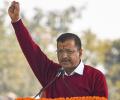
Kejriwal runs his party with the proverbial iron fist and has learnt to temper his aggression, say people close to him.

Ignoring all previous protests and opposition to the deal, the saffron party has changed its stance, without providing any explanation. What has changed? Accountability and explanations on this U-turn will be welcomed.

Terming the state "pride" of the country, Modi said it is the gateway of the nation as it guards the frontier. It is the duty of the government to develop the state at any cost, he said.

The AAP chief said the BJP had tried to polarise the assembly polls and that they hadn't cleared the Shaheen Bagh road because of the elections.
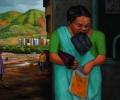
It is impossible for Mumbaikars not to glimpse themselves or someone they know in Sudhir Patwardhan's paintings.

Finance Minister Nirmala Sitharaman on Monday presented the Budget for 2021-22 in the Lok Sabha that is expected to provide relief to the pandemic-hit common man as well as focus more on driving economic recovery through higher spending on healthcare, infrastructure and defence amid rising tensions with neighbours, As India emerges from the COVID-19 crisis, the ninth Budget under the Modi government, including an interim one, is widely expected to focus on boosting spending on job creation and rural development, generous allocations for development schemes, putting more money in the hands of the average taxpayer and easing rules to attract foreign investments.
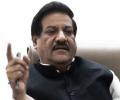
Water scarcity condition in Maharashtra has become "critical" due to deficit rainfall, Chief Minister Prithviraj Chavan said on Wednesday while asking citizens to save water and use electricity carefully.

Here's the full text of President Ram Nath Kovind's customary address to the joining sitting of Parliament on the first day of the budget session.

With the cyclone set to make landfall on Wednesday, Maharashtra and Gujarat activated their disaster response mechanism, deploying NDRF teams and evacuating people from areas likely to be hit.
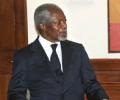
Former UN Secretary General Kofi Annan has warned India against too many populist subsidies
The average rating was seven out of 10.

While consumers will be paying a higher upfront cost for smart metering, the share in the efficiency gains could more than offset this higher spend
The government has garnered Rs 2 lakh crore by auctioning 33 blocks.
India has achieved 100 per cent electrical connectivity, but 100 per cent electrification remains a long-drawn task, says Shreya Jai.

Delhi Chief Minister Arvind Kejriwal and his Bihar counterpart Nitish Kumr on Thursday jointly attacked the Centre calling it "anti-poor and anti-farmer" and asserted that the people will give it a "befitting reply".
Paving the way for the first set of labour reforms in the country, President Pranab Mukherjee has given his assent to Rajasthan's amendments to three laws.
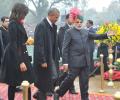
The tactics deployed by Obama to bring India on board, which was the only major power in his way of the climate deal, was described by his former top personal and national security aide Benjamin Rhodes in a podcast interview.

However, it is immediately not clear whether the relaxation will be given fully or partially.

Arvind Kejriwal, engineer, civil servant and Delhi's man with a development agenda, is the David who slayed the government's Goliath.

Why do hundreds, and in some cases, thousands, turn up for a single vacancy at the lowest rungs of government jobs? The answer is simple: It offers a stable, assured income, which overcomes all other objections, says Shreekant Sambrani.
The court on Tuesday ordered BSES -- part of billionaire Anil Ambani's Reliance Infrastructure Ltd to pay state-run NTPC the Rs 700 crore (Rs 7 billion) it is owed by May 31.

Flagging the challenge of raising foodgrain production, Prime Minister Manmohan Singh on Friday promised all assistance to states for improving agricultural growth.
